Preparing for IELTS on Your Own: A Step-by-Step System
Updated
Self-study works if you have a system. Without a system it turns into endless mock tests with no real progress.
Step 1. Diagnostics
Take a full mock test under exam conditions: all papers back-to-back, with a timer, without a dictionary. Record your band score for each paper and the question types where you make the most mistakes.
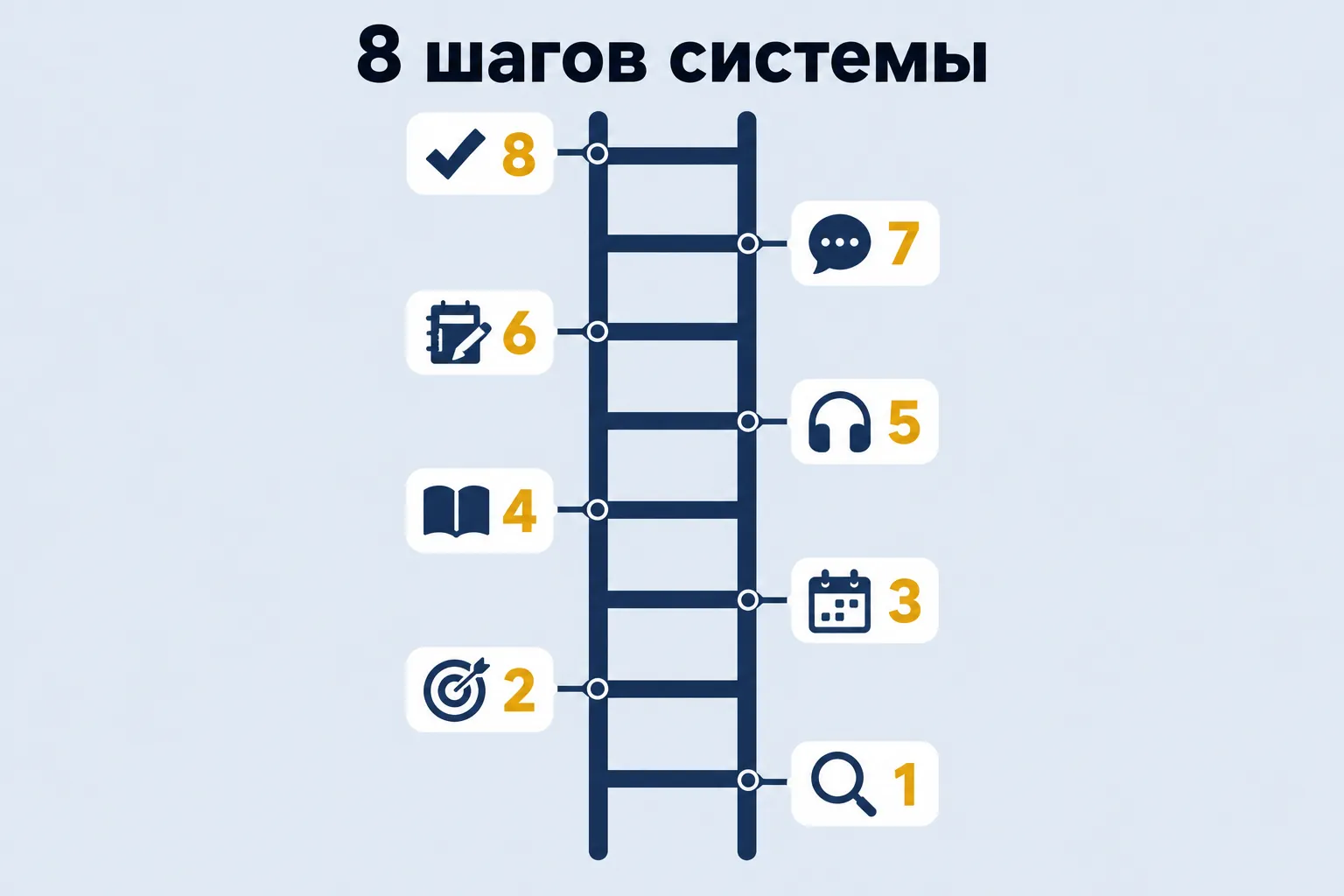
Step 2. Goal and timeline
- What band score do you need: only an Overall band score or a minimum in each paper?
- When is your test? How many hours per week can you realistically study?
For timeline guidance, see the article «How Long to Prepare for IELTS».
Step 3. Learn the format and assessment criteria
- IELTS Academic format and all question types.
- IELTS Writing assessment criteria — read the official band descriptors in English as well.
Step 4. Allocate your time
40% — on your weakest skill, 30% — on the second weakest, 15% each — on the remaining two.
Step 5. Practise by skill
Listening: one to two sections a day with analysis using the transcript. Learn more in «IELTS Listening».
Reading: one to two passages a day with a timer and a paraphrase bank. Learn more in «IELTS Reading».
Writing: 2–3 texts per week, each checked against the four criteria — Task Achievement / Task Response, Coherence and Cohesion, Lexical Resource, Grammatical Range and Accuracy — and then rewritten. Learn more in «IELTS Writing».
Speaking: 15 minutes a day aloud with a voice recorder, practising Part 1, Part 2 cue card and Part 3. Focus on Fluency and Coherence, Lexical Resource, Grammatical Range and Accuracy and Pronunciation. Learn more in «IELTS Speaking».
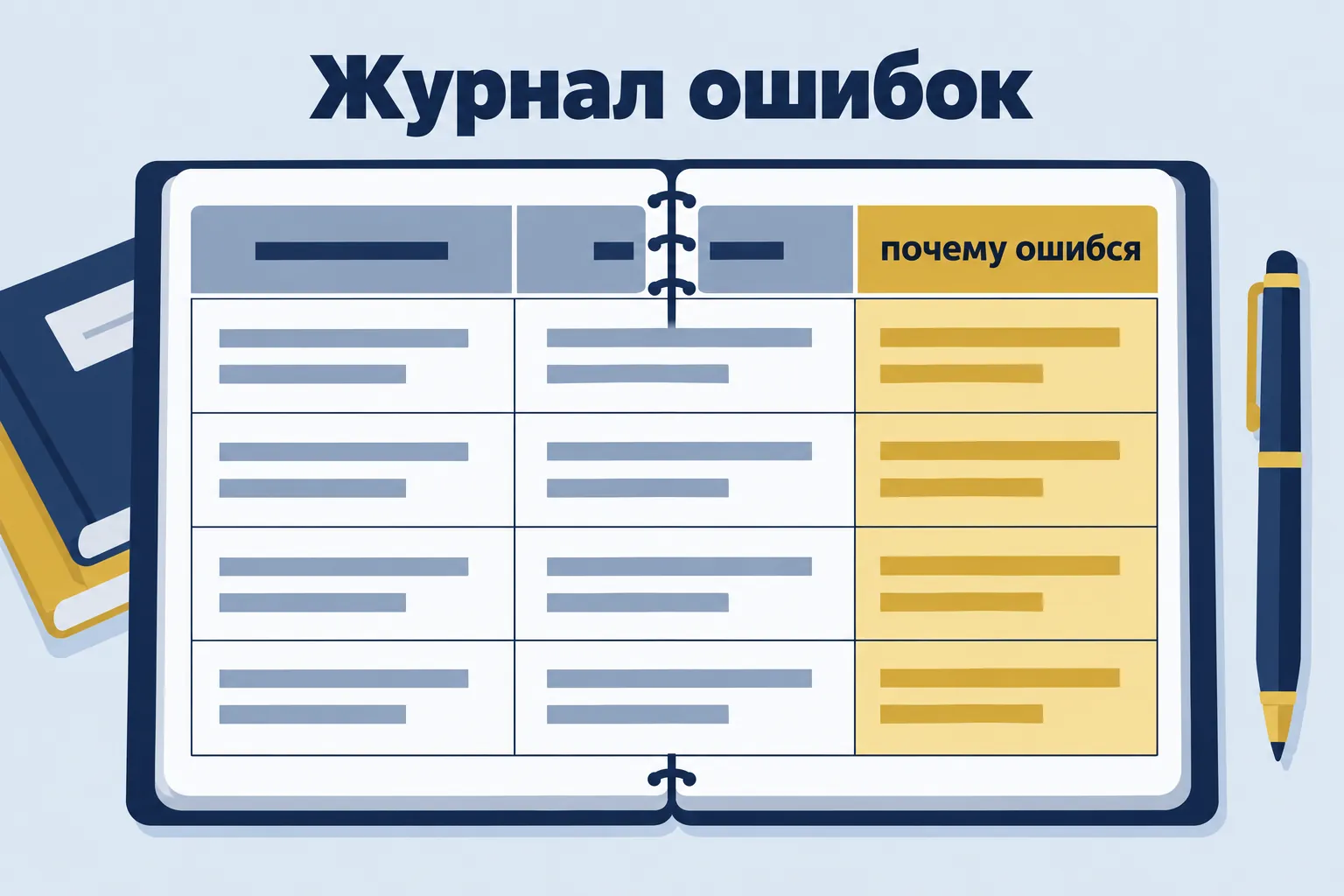
Step 6. Error log
Log every mistake with a specific reason: “did not recognise paraphrase”, “False instead of Not Given”, “exceeded word limit”, “missed article”. After a month, three to five recurring reasons will emerge — that is your personalised programme.
Step 7. Feedback for Writing and Speaking
Without feedback, productive skills improve slowly. Options:
- a teacher who knows the IELTS assessment criteria;
- an AI check against the four criteria;
- strict self-assessment: put your text aside for a day, compare it with the band descriptors, and check it against your list of typical mistakes.
Step 8. Exam mode
For the final 2–3 weeks, do one to two full mock tests per week on the schedule of the real exam. Take your last full mock test 5–6 days before the test at your test centre time slot.
Materials
For a curated list of textbooks, see «Best Textbooks for IELTS Preparation»; for free resources, see «Free IELTS Preparation».
If your target is 7.5 and above
Detailed 12-, 8- and 4-week plans, an error log template, 15 common mistakes made by test takers from India, Pakistan, Nigeria and the Philippines, and test-day tactics are all collected in the guide «IELTS Academic 8+».
FAQ
Can I prepare for IELTS on my own?
Yes. Listening and Reading can be prepared very effectively on your own. For Writing and Speaking you need feedback against the assessment criteria: from a teacher, from an AI check, or at least strict self-assessment.
Where should I start my IELTS preparation?
With a full mock test under exam conditions to find out your band score for each paper.
Next step
Mock test
IELTS mock test
Listening, Reading, Writing and Speaking in the computer-based test format and IELTS band forecast on the 0–9 scale.
6 USDone-time
Go to mock testGuide
IELTS Academic for 8+: The Complete Preparation Strategy
The complete strategy: from diagnosis to exam day. No filler and no memorised templates.
15 USD
Open guide