IELTS Listening: Traps, Question Types and Tips for a High Band Score
Updated
Listening lasts about 30 minutes: 4 parts, 40 questions, the recording is played once only. On computer you get 2 minutes at the end to check your answers.
The Four Parts
- Everyday dialogue (enrolling on a course, making a booking). Usually form completion: names, numbers, dates.
- Everyday monologue (tour, announcement). Often a map and multiple choice.
- Academic discussion between two or three people. Multiple choice and matching. The trickiest part: speakers change their minds.
- Academic lecture. Note completion, fast pace.
Five Common Traps
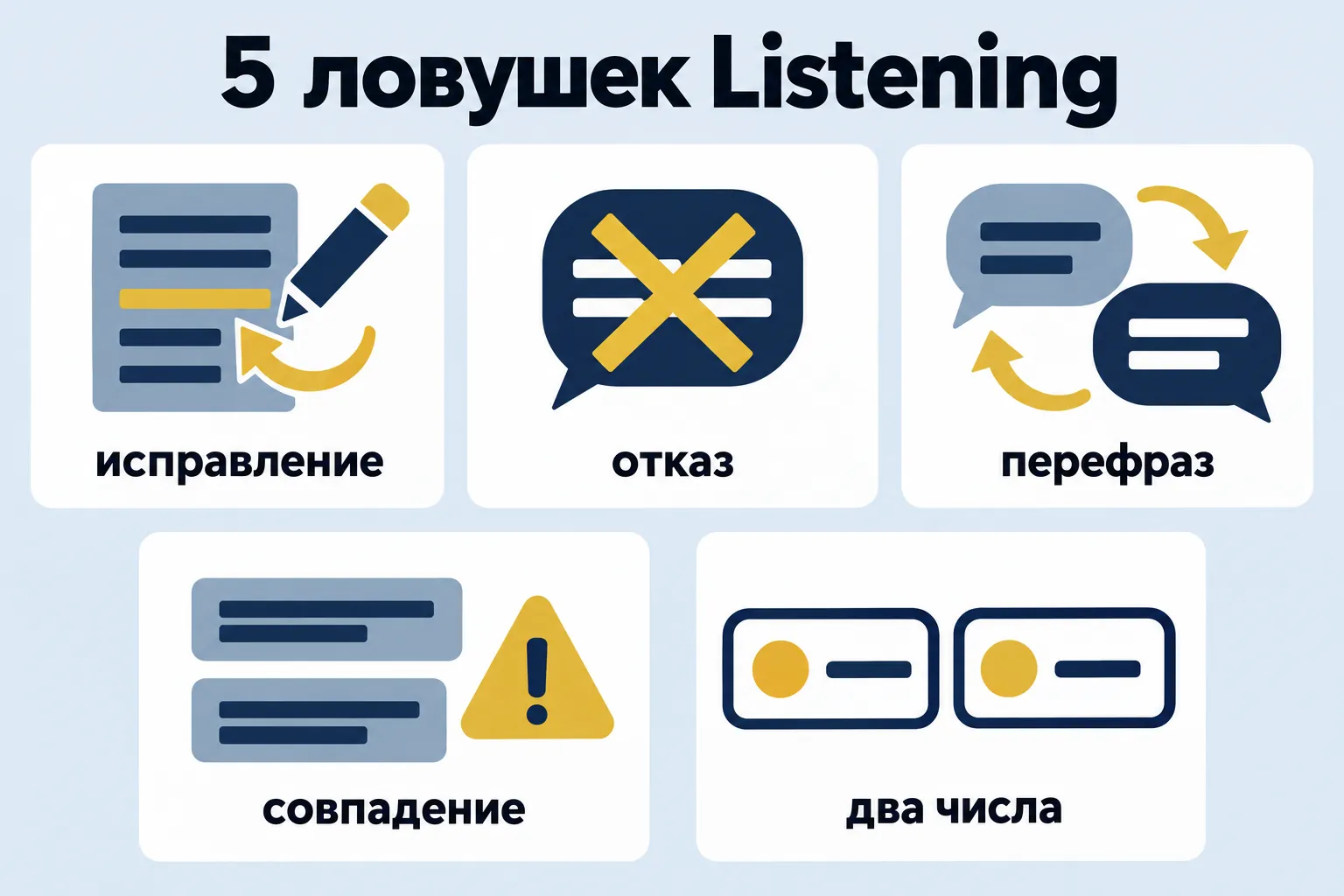
- Correction. It's on the 14th... sorry, the 16th. The last version is correct.
- Rejected option. Students discuss ideas and reject them. The answer is what they finally agree on.
- Paraphrase. Words in the question and in the recording are different: problem in the question, what made it unsuitable in the recording.
- Distractor with word matching. A word from option B is heard, but in a different context. An exact word match is suspicious.
- Two numbers close together. It used to cost $250, but now it's $280. Read carefully what the question actually asks.
Rules for Writing Answers
- Word limit in the instructions is part of the answer. Three words where only two are allowed is marked wrong.
- Spelling counts. Learn these separately: accommodation, environment, government, necessary, Wednesday, February.
- Plural: a missing -s makes the answer incorrect.
- Write numbers as digits.
How to Answer by Question Type
- Gap fill (completion): before the recording, predict the answer type (number, name, singular or plural noun).
- Multiple choice: highlight how the options differ, listen until the end of the turn.
- Maps: find the starting point and note direction words (opposite, next to, beyond, at the far end).
- Matching: learn the meaning of the options before the recording starts and keep the list in front of you.
How to Practise Effectively
Just doing a test and counting your band score achieves almost nothing. Real progress comes from analysis:
- Do one section under exam conditions.
- Mark your mistakes without looking at the correct answers.
- Listen again and try to catch the answer.
- Open the transcript, find the paraphrase and the trap.
- Write the mistake and the rule for next time in an error log.
One section analysed this way is more useful than three done just "for a score".
How Many Correct Answers for a High Band Score
As a rough guide, 30–31 correct answers give you 7.0, 35–36 give you 8.0, 39–40 give you 9.0. See the full conversion table in the article “IELTS Band Scores”.
What Next
All seven traps with examples, tactics for each question type, common listening mistakes and a three-week plan — in the Listening guide.
FAQ
How many times is the recording played in IELTS Listening?
Once only.
Does spelling count in Listening?
Yes. An answer with a spelling mistake is marked as incorrect.
Can I write numbers as digits?
Yes, and it is safer: there is less risk of a spelling mistake and exceeding the word limit.
Next step
Mock test
IELTS mock test
Listening, Reading, Writing and Speaking in the computer-based test format and IELTS band forecast on the 0–9 scale.
6 USDone-time
Go to mock testGuide
IELTS Listening for 8.5–9: technique with no wasted marks
Listening offers the fastest boost to your Overall band score. Here you can see exactly where you are losing marks and how to fix it.
15 USD
Open guide