IELTS Speaking: How It Works and How to Score Band 8–9
Updated
Speaking is an 11–14 minute interview with an examiner. The interview is recorded, and the examiner awards your band score against four band descriptors.
Three Parts
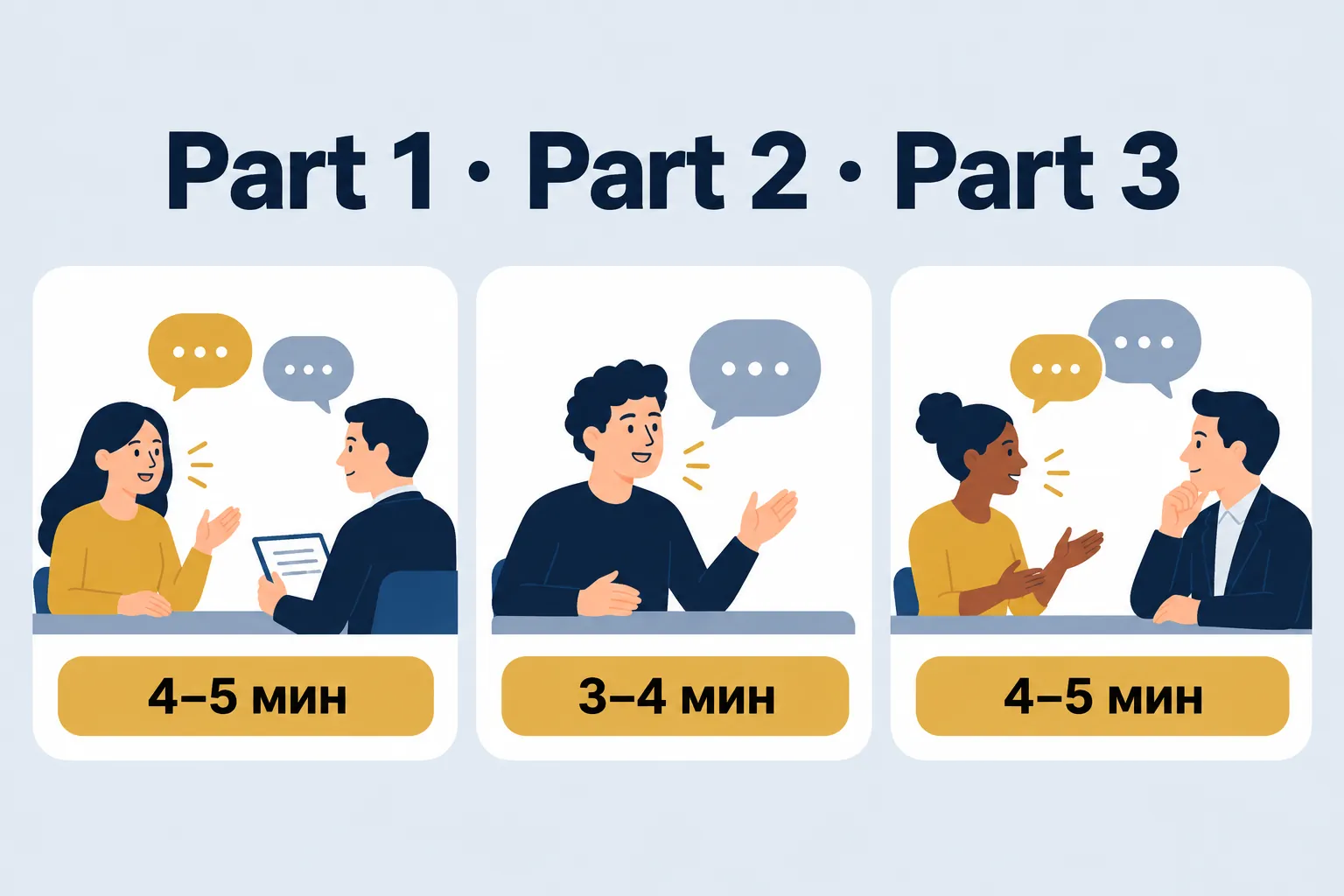
| Part | Time | What happens |
|---|---|---|
| Part 1 | 4–5 minutes | Questions about you: studies, work, home, hobbies and everyday topics |
| Part 2 | 3–4 minutes | A cue card with a topic, one minute to prepare, then a talk for up to 2 minutes |
| Part 3 | 4–5 minutes | Abstract discussion linked to the topic in Part 2 |
Four Band Descriptors
- Fluency and Coherence. Not speed, but speaking without long hesitations while searching for words, and staying coherent and logical.
- Lexical Resource. Precise and natural vocabulary and the ability to paraphrase.
- Grammatical Range and Accuracy. A range of structures and a high proportion of error-free sentences.
- Pronunciation. Clarity, word stress, intonation and rhythm. Any accent is acceptable if you are easy to understand.
Part 1: Short but Developed
Aim for 2–4 sentences: a direct answer + a reason or detail.
Do you like cooking? I do, although I enjoy it more at weekends than on weekdays. During the week it's mostly about getting something on the table quickly, but on Sundays I'll try out a new recipe.
Part 2: Notes, Not a Script
During the one-minute preparation, write 2–4 keywords for each bullet point on the cue card. Do not write full sentences. Keep speaking until the examiner stops you — that is normal. The last bullet point (explain why...) is where you show reasoning, not just description. This is where your level becomes clear.
Part 3: Think Out Loud
Use this structure: position → explanation → example → qualification. Use generalisations (on the whole), comparisons (compared to a generation ago), hypothetical language (if..., we'd probably...) and hedging (I'd say, to some extent).
What Lowers Your Score
- one-word or very short answers in Part 1;
- memorised answers and formulaic phrases;
- long pauses while searching for words;
- constant self-correction;
- flat, monotonous intonation.
How to Practise Without a Partner
- Record yourself and listen back to the whole recording. This is the most underrated tip.
- Listen to each recording focusing on one descriptor at a time: hesitations, word repetition, grammar slips, pronunciation.
- Transcribe one recording per week and count how many times you said very or people.
- For each topic, prepare vocabulary and 2–3 personal stories, not a full script.
What Next
Sample answers at Band 8 with analysis, pronunciation guidance (sounds, word stress, intonation), strategies for difficult moments and a three-week plan — in the Speaking guide.
FAQ
How long is IELTS Speaking?
11–14 minutes: Part 1 is 4–5 minutes, Part 2 is 3–4 minutes, Part 3 is 4–5 minutes.
Do I need a British accent?
No. Pronunciation is assessed on clarity, word stress, intonation and rhythm, not on a specific accent.
Can I ask the examiner to repeat the question?
Yes, you can. It does not lower your band score.
Can I memorise answers in advance?
You should not. Examiners are trained to recognise memorised answers, and they do not help your score.
Next step
Mock test
IELTS mock test
Listening, Reading, Writing and Speaking in the computer-based test format and IELTS band forecast on the 0–9 scale.
6 USDone-time
Go to mock testGuide
IELTS Speaking at 8–9: Speak Fluently, Not from a Template
The examiner is not assessing your opinions or your life story, but how well you use the language. We break down what that means in practice.
15 USD
Open guide