IELTS Tasks: All Question Types in Listening, Reading, Writing and Speaking
Updated
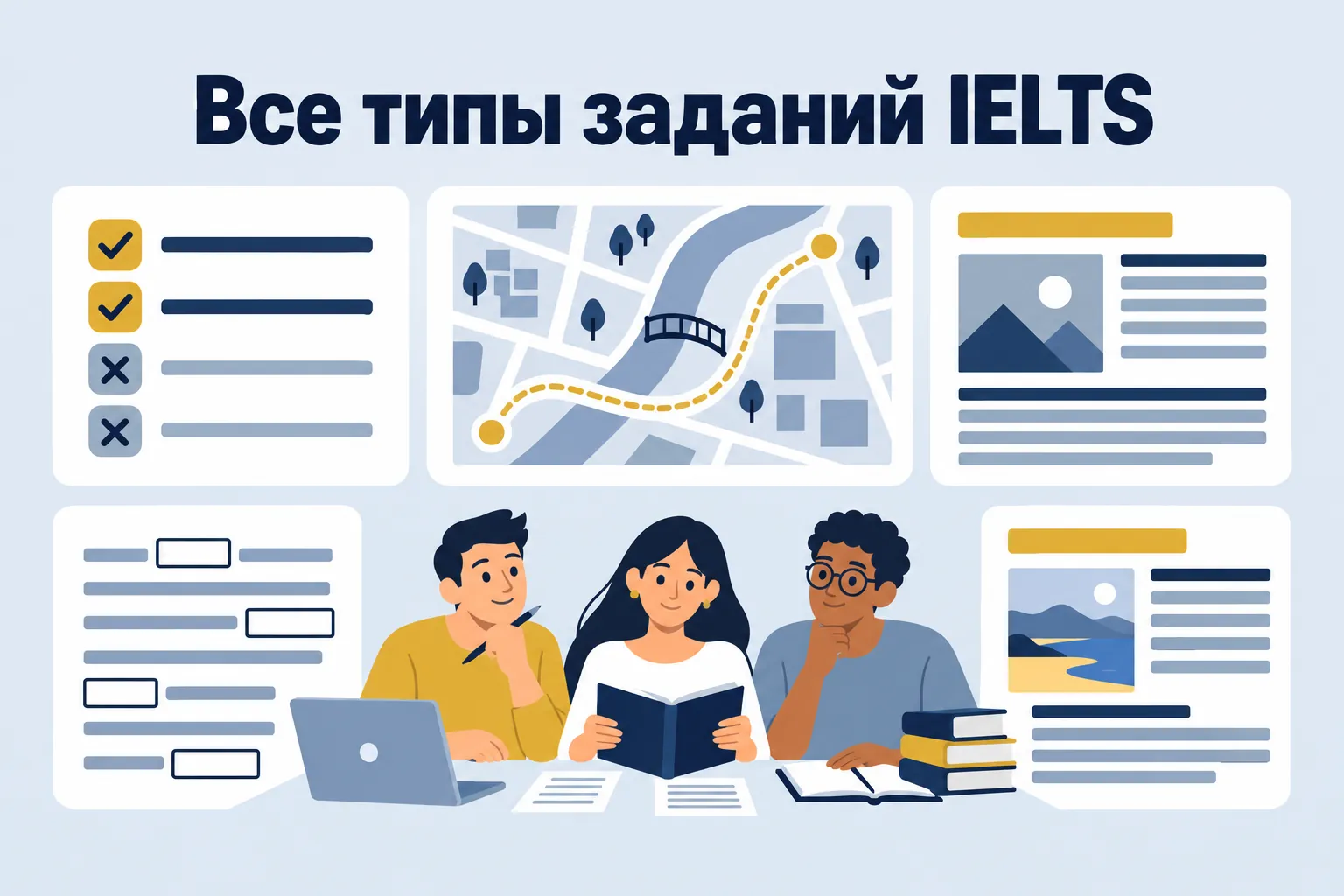
Every IELTS test is built from the same set of task types. If you know them in advance, there will be no surprises on test day and you can spend your time on answers instead of reading instructions.
Listening: 40 questions, 4 parts
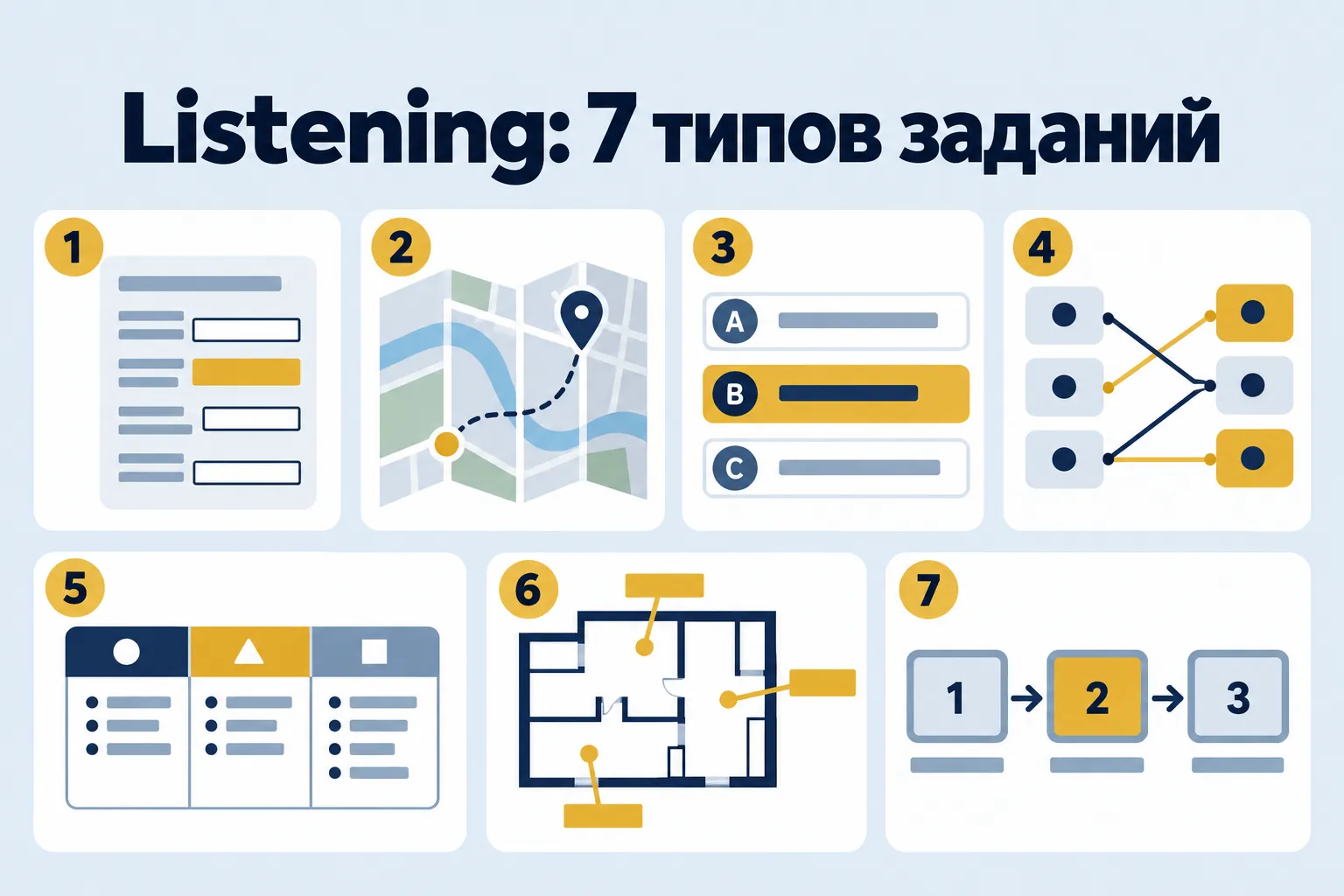
| Task type | What to do | What to watch for |
|---|---|---|
| Form / note / table completion | fill gaps in a form, notes or table | word limit, spelling, numbers |
| Sentence completion | complete sentences | grammar of the gap |
| Multiple choice | choose one or two answers | traps with corrections and rejections |
| Matching | match statements to options | options are not in order |
| Map / plan labelling | label places on a map or plan | starting point and direction words |
| Flow-chart / diagram labelling | complete a process diagram | order of stages |
| Short answer | give a short answer to a question | word limit |
For more on traps, see the article “IELTS Listening”.
Reading: 40 questions, 3 passages
| Task type | What to do | Order of answers in the passage |
|---|---|---|
| True / False / Not Given | check facts | in order |
| Yes / No / Not Given | check the writer's opinion | in order |
| Multiple choice | choose the answer | in order |
| Matching headings | match headings to paragraphs | by paragraph |
| Matching information | find the paragraph containing information | not in order |
| Matching features | match statements to people, dates, etc. | not in order |
| Matching sentence endings | match beginnings and endings of sentences | in order |
| Sentence / summary / note / table completion | fill gaps | usually in order |
| Diagram labelling | label a diagram | usually in order |
| Short answer | give a short answer | in order |
The most difficult type has its own article: “True / False / Not Given”. For overall Reading strategy, see “IELTS Reading”.

Writing: 2 tasks
- Task 1 Academic: describe a graph, table, chart, process or map. At least 150 words. More detail: Writing Task 1.
- Task 2: an essay of one of five types (opinion, discussion, advantages/disadvantages, problem/solution, two-part question). At least 250 words. More detail: Writing Task 2.
Speaking: 3 parts
- Part 1: questions about you and everyday topics.
- Part 2: a long turn with a cue card — up to 2 minutes after 1 minute of preparation.
- Part 3: discussion of more abstract topics.
Sample questions are collected in the article “IELTS Speaking Topics 2026”.
Example: what a completion task looks like
Complete the notes below. Write ONE WORD AND/OR A NUMBER for each answer.
Community garden project – Meetings every (1) ______ evening – Membership fee: $(2) ______ per year – Bring your own (3) ______
Before you listen, predict: (1) a day of the week, (2) a number, (3) a noun, most likely a tool or gloves. This prediction saves seconds and protects you from format errors.
How to practise task types
Do not practise everything at random. Take a mock test, see which question types cause the most errors, and practise those types specifically with 15–20 questions a day. Strategies for each type are collected in the guides for Listening and Reading.
FAQ
How many questions are there in IELTS?
40 in Listening and 40 in Reading. In Writing there are two tasks, in Speaking there are three parts.
Which IELTS task is the most difficult?
Most test takers find True / False / Not Given and matching headings in Reading, Part 3 in Listening and Writing Task 2 the most challenging.
Next step
Mock test
IELTS mock test
Listening, Reading, Writing and Speaking in the computer-based test format and IELTS band forecast on the 0–9 scale.
6 USDone-time
Go to mock testGuide
IELTS Academic for 8+: The Complete Preparation Strategy
The complete strategy: from diagnosis to exam day. No filler and no memorised templates.
15 USD
Open guide