IELTS Academic Format in 2026: Sections, Timing and Tasks
Updated
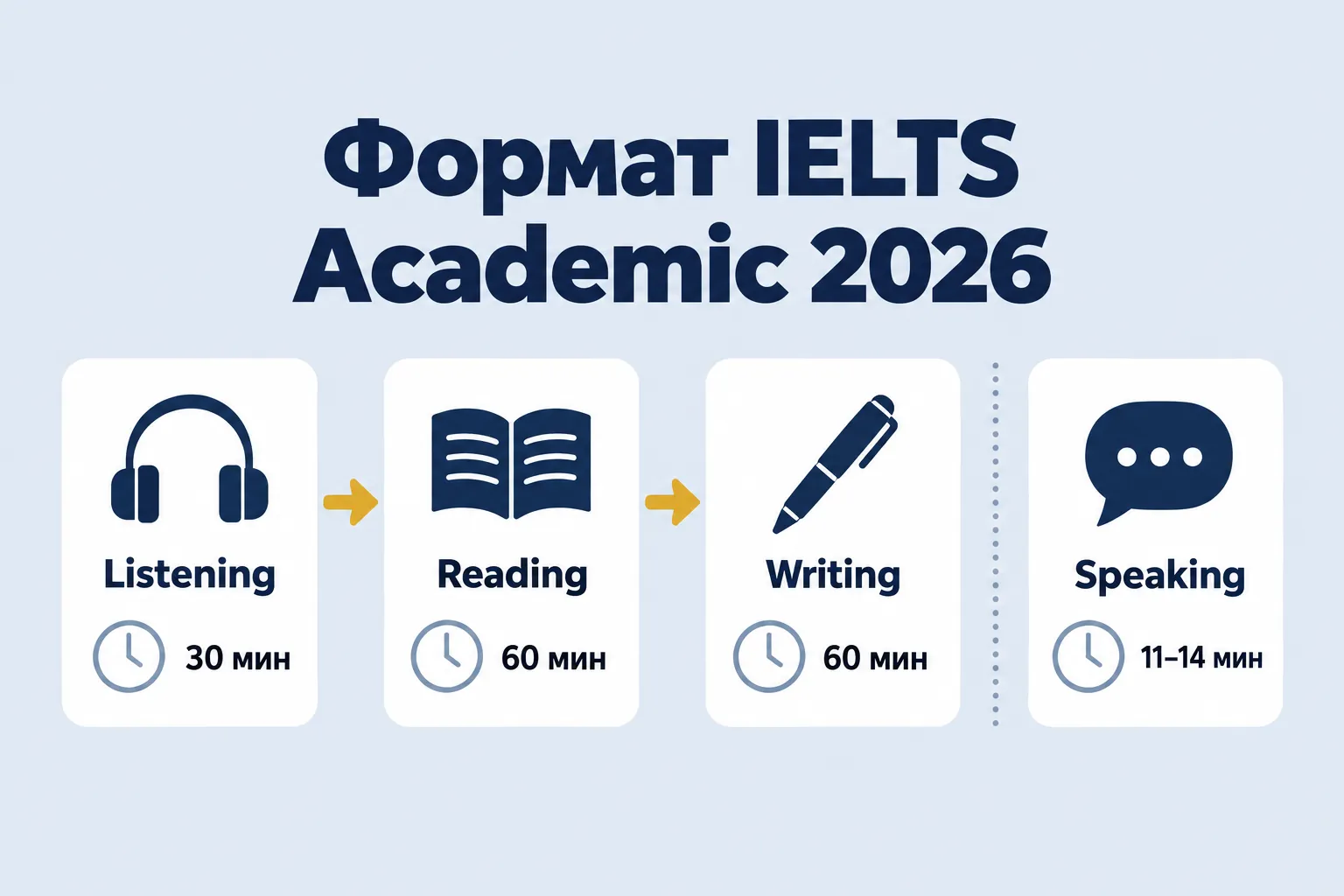
IELTS Academic is taken for university admission and professional registration in English-speaking countries. It is widely used by test takers from India, Pakistan, Nigeria and the Philippines who apply to universities in the UK, Australia, Canada and other destinations. The test assesses four skills and lasts about 2 hours 45 minutes.
At a glance
| Section | Time | Tasks | Scoring |
|---|---|---|---|
| Listening | about 30 minutes | 4 parts, 40 questions | raw score out of 40 → band score |
| Reading | 60 minutes | 3 texts, 40 questions | raw score out of 40 → band score |
| Writing | 60 minutes | Task 1 (at least 150 words) and Task 2 (at least 250 words) | 4 criteria |
| Speaking | 11–14 minutes | 3 parts, face-to-face interview with an examiner | 4 criteria |
Listening, Reading and Writing are taken consecutively on the same day without breaks. Speaking takes place on the same day or within about a week before or after the main test day.
Computer or paper
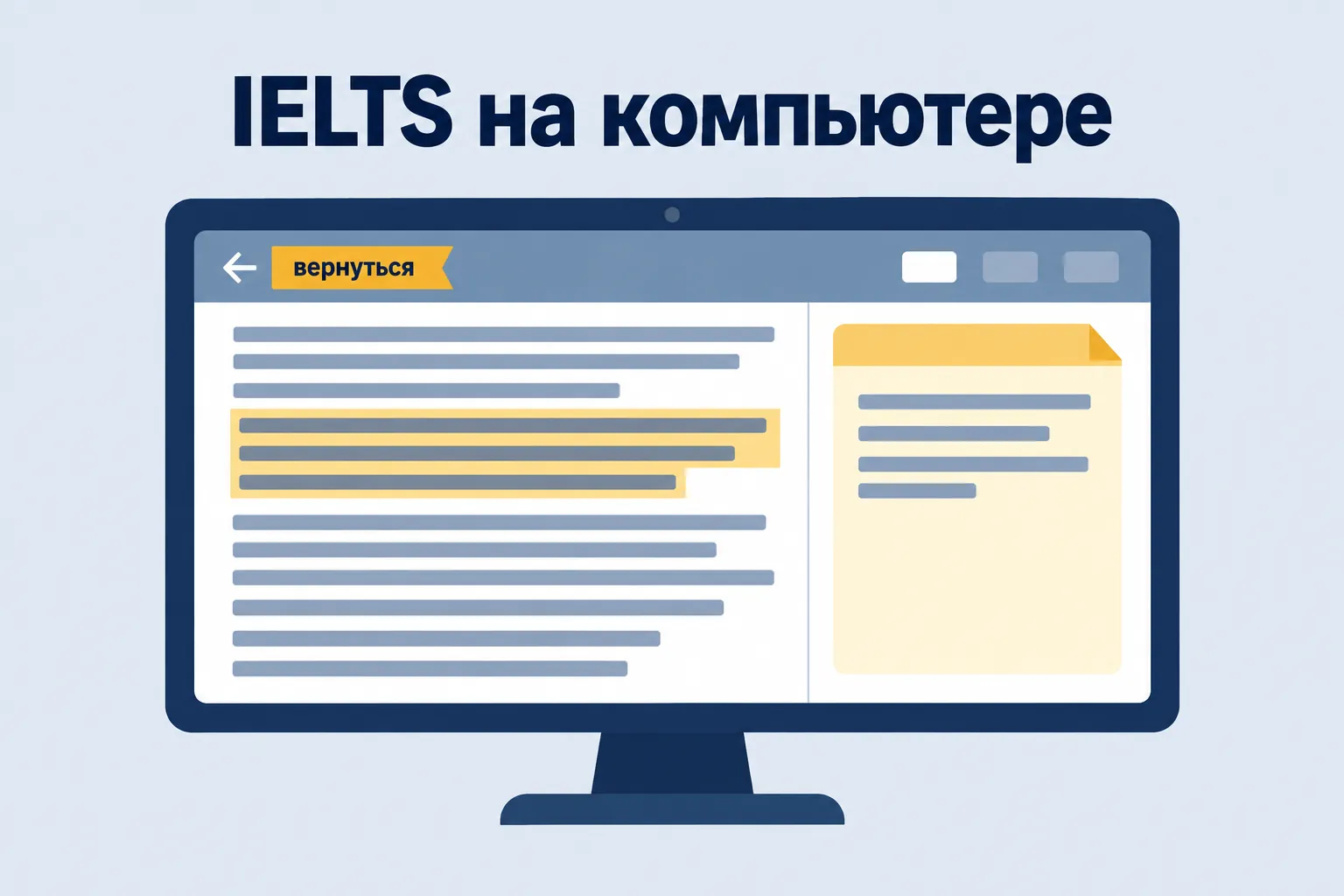
From mid-2026 IELTS is moving to a computer-delivered format, with timelines varying by country. In some countries a hybrid model remains: Listening and Reading on computer, Writing by hand. Speaking is always conducted face-to-face with an examiner, regardless of format.
On computer, you get 2 minutes at the end of Listening to check your answers. You enter answers directly on screen, you can highlight text and make notes in Reading, and you can flag questions for review. If you have practised mainly with paper-based books, be sure to practise with the computer interface as well: navigation and typing take time to get used to.
Listening
Four parts with 10 questions each, the recording is played once, and difficulty increases from Part 1 to Part 4.
- Everyday dialogue: enrolling on a course, making a booking, placing an order. Often form completion.
- Everyday monologue: a tour, an announcement, a talk about a service. Often a map or plan.
- Academic discussion between two or three people. Multiple choice and matching.
- Academic lecture. Usually note completion.
Task types: form, note, table and sentence completion, multiple choice, matching, maps and plans, diagrams. For more on traps and how to avoid them, see IELTS Listening: traps and tips.
Reading
Three texts from popular-science sources, about 2,500–2,800 words in total. The texts are intended for a non-specialist audience and no specialist knowledge is required. Difficulty increases from the first text to the third. There is no extra time to transfer answers.
Task types: True / False / Not Given, Yes / No / Not Given, multiple choice, matching headings, matching information, matching features, matching sentence endings, sentence completion, summary, table, diagram and short-answer questions. The most difficult task for most test takers is True / False / Not Given.
Writing
- Task 1: description of a chart, table, diagram, process or map. At least 150 words, about 20 minutes. No opinion is required. Learn more: Writing Task 1.
- Task 2: an essay on a general topic with argumentation. At least 250 words, about 40 minutes. Learn more: Writing Task 2.
Task 2 carries twice the weight of Task 1. Both tasks are assessed against four criteria: Task Achievement (Task 1) / Task Response (Task 2), Coherence and Cohesion, Lexical Resource, and Grammatical Range and Accuracy.
Speaking
- Part 1 (4–5 minutes): questions about you and everyday topics.
- Part 2 (3–4 minutes): a cue card with a topic, one minute to prepare, a talk for up to two minutes.
- Part 3 (4–5 minutes): discussion of more abstract issues related to Part 2.
Assessment criteria: Fluency and Coherence, Lexical Resource, Grammatical Range and Accuracy, and Pronunciation. Learn more: IELTS Speaking.
How the result is calculated
Each section receives a band score from 0 to 9 in steps of 0.5. The Overall band score is the average of the four sections, rounded to the nearest 0.5 or whole band (.25 → .5 and .75 → next whole band). For tables and examples, see IELTS band scores.
What next
The best way to understand the format is to experience it in full. A full mock test on our platform replicates the computer-delivered IELTS interface and shows an IELTS band forecast for each section. You can practise regularly, review your mistakes and organise your preparation in your dashboard.
FAQ
How long is the IELTS test?
About 2 hours 45 minutes in total: Listening about 30 minutes, Reading 60 minutes, Writing 60 minutes and Speaking 11–14 minutes.
Can I take IELTS on paper in 2026?
IELTS is moving to computer-delivered format from mid-2026, with timelines varying by country. In some markets a hybrid model remains where Writing is completed by hand. Check the format at your chosen test centre.
Is Speaking on the same day?
Not always. Speaking may take place on the same day as the main test or within about a week before or after it.
What is the difference between Academic and General Training?
Listening and Speaking are the same. Reading and Writing differ: Academic uses popular-science texts and a chart description in Task 1, while General Training uses everyday and workplace texts and a letter in Task 1.
Next step
Mock test
IELTS mock test
Listening, Reading, Writing and Speaking in the computer-based test format and IELTS band forecast on the 0–9 scale.
6 USDone-time
Go to mock testGuide
IELTS Academic for 8+: The Complete Preparation Strategy
The complete strategy: from diagnosis to exam day. No filler and no memorised templates.
15 USD
Open guide