IELTS Writing Marking Criteria Explained Simply: How Band 6 Differs from 7 and 8
Updated
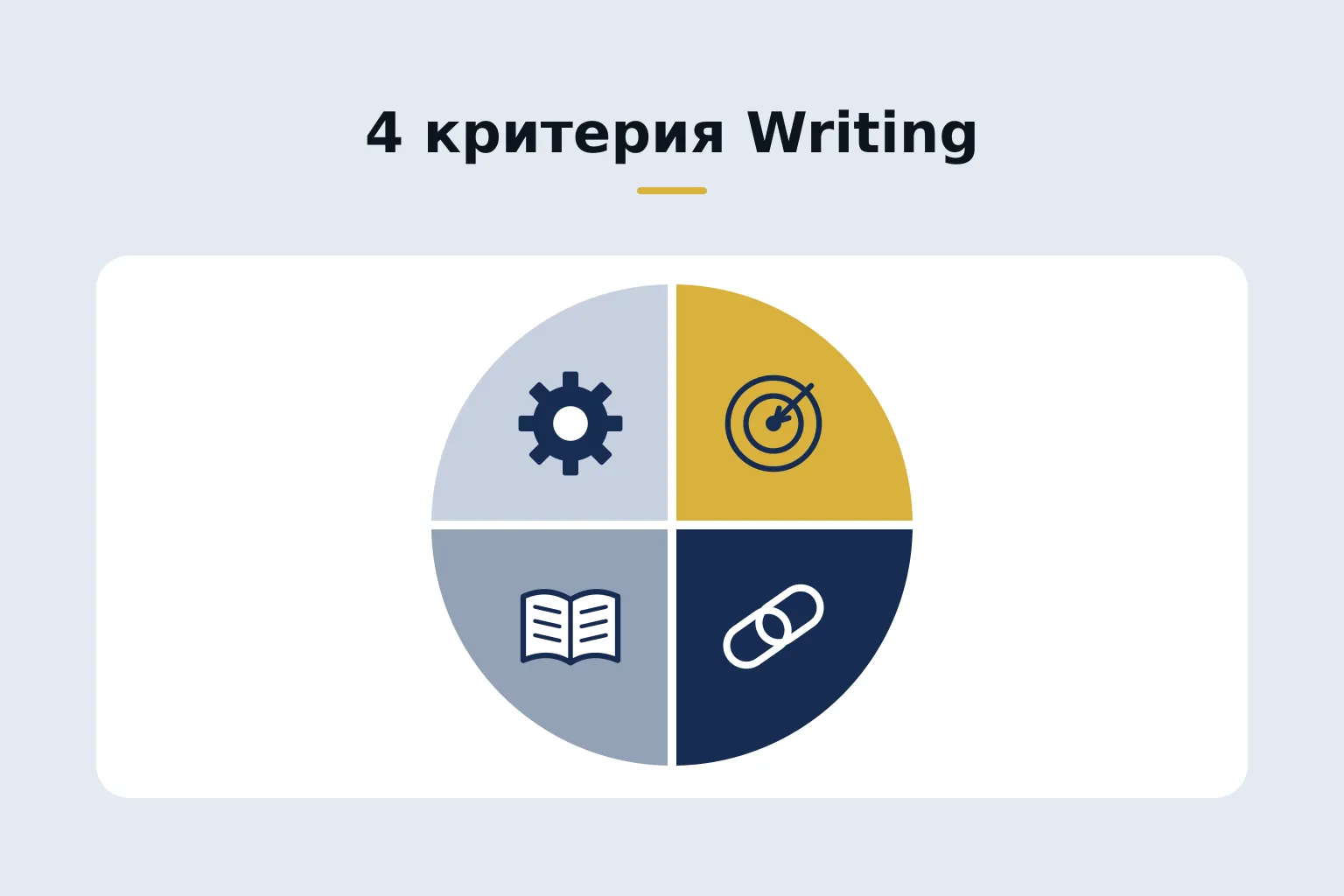
Writing is assessed against four criteria, each worth 25%. The official band descriptors are published on ielts.org. We recommend reading them in the original, and here we explain what they mean in plain English and show what changes from band to band.
1. Task Achievement (Task 1) and Task Response (Task 2)
What is assessed: whether you have fully and relevantly answered the task.
| Band | What it looks like |
|---|---|
| 6 | All parts of the task are addressed, but some are covered only superficially. A position is present but sometimes unclear. In Task 1, an overview is present but inaccurate or incomplete. |
| 7 | All parts are addressed, the position is clear throughout. Main ideas are developed, but sometimes too generally. |
| 8 | All parts are addressed in sufficient depth. Ideas are well developed and supported, the position is consistent and well argued. |
What raises your score: answer every part of the question, develop one idea in depth rather than three ideas superficially, maintain a clear position from introduction to conclusion.
2. Coherence and Cohesion
What is assessed: whether your text is logical and how well its parts are connected.
| Band | What it looks like |
|---|---|
| 6 | There is an overall logic, linking words are used but mechanically or with inaccuracies. Paragraphing is not always logical. |
| 7 | Logical organisation, clear progression, a range of linking devices, though sometimes overused. |
| 8 | Consistent logic, cohesion is natural and seamless, paragraphing is appropriate and well managed. |
What raises your score: fewer mechanical linkers such as Moreover and Furthermore, more cohesion through pronouns and referencing (this trend, such measures, the former), one paragraph — one central idea.
3. Lexical Resource
What is assessed: your range of vocabulary and precision of use.
| Band | What it looks like |
|---|---|
| 6 | Adequate range for the task, attempts at less common vocabulary, noticeable errors in word choice and spelling. |
| 7 | Flexible range, some less common words and collocations, occasional inaccuracies. |
| 8 | Wide range, fluent and precise use, only rare errors. |
What raises your score: accurate collocation (a growing body of evidence, to raise awareness), paraphrasing instead of repetition, avoiding showy vocabulary for effect.
4. Grammatical Range and Accuracy
What is assessed: the range of structures and their accuracy.
| Band | What it looks like |
|---|---|
| 6 | A mix of simple and complex sentences, errors occur but rarely reduce clarity. |
| 7 | A variety of complex structures, many sentences are error-free. |
| 8 | A wide range of structures, most sentences are error-free. |
What raises your score: the proportion of error-free sentences. Complexity you can control is more valuable than long sentences with errors.
What lowers your score under any criterion
- text shorter than 150 words in Task 1 / 250 words in Task 2;
- off-topic response;
- memorised chunks;
- no paragraphing or text presented as a list;
- no overview in Task 1.
How to use the criteria in your preparation
- Print the official descriptors and highlight the key words for bands 6, 7 and 8.
- After each essay, assess yourself separately for each criterion.
- Choose the criterion that is lowest and focus on it for two weeks.
- Get external feedback: self-assessment is usually half a band higher than the real score.
For sample answers analysed against each criterion and a feedback cycle to organise your practice, see the Writing guide.
FAQ
Where can I find the official IELTS Writing criteria?
The public band descriptors are published on ielts.org as a PDF. The wording was last updated in May 2023.
Do all criteria carry equal weight?
Yes, 25% each. But Task 2 counts for twice as much as Task 1 in your overall Writing band score.
Why do I get 6.5 even though I make few mistakes?
Most often the problem is Task Response (ideas are not fully developed or not all parts of the question are addressed) or Coherence and Cohesion (mechanical linking). Accuracy alone does not give you a band 7.
Next step
Mock test
IELTS mock test
Listening, Reading, Writing and Speaking in the computer-based test format and IELTS band forecast on the 0–9 scale.
6 USDone-time
Go to mock testGuide
IELTS Writing at 8–9: How Top-Level Texts Are Written
Writing is the most difficult part of the exam for most test takers. Here we break down what actually earns an 8 and why 'clever words' do not help.
15 USD
Open guide