What is IELTS: exam, band scores, cost and preparation in 2026
Updated
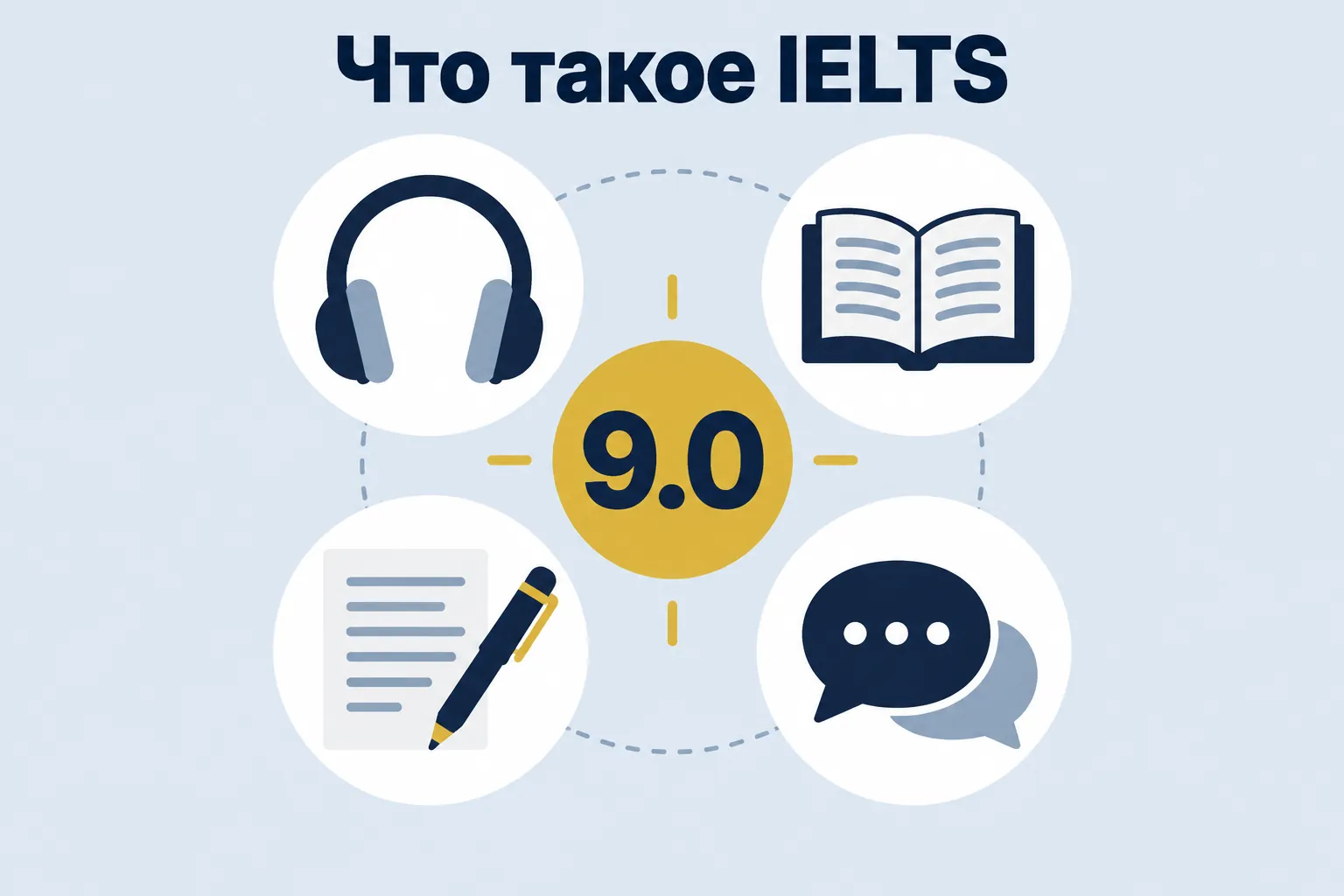
IELTS (International English Language Testing System) is an international English language test. Its result is required for admission to universities abroad, for work and professional registration overseas, and for immigration programmes. IELTS is accepted by thousands of organisations in the United Kingdom, Australia, Canada, New Zealand, Europe, Asia and the United States. Test takers from India, Pakistan, Nigeria and the Philippines commonly use IELTS for study, work and migration to these destinations.
IELTS Test is not affiliated with IELTS, the British Council, IDP or Cambridge. We are an independent preparation platform.
Two versions of the test
- IELTS Academic — for admission to undergraduate, postgraduate and doctoral programmes and for professional registration (for example, doctors, nurses, lawyers).
- IELTS General Training — for work, secondary education and immigration to a number of countries.
Listening and Speaking are the same in both versions, while Reading and Writing are different. Learn more about the differences in the article IELTS Academic or General Training.
What the test consists of
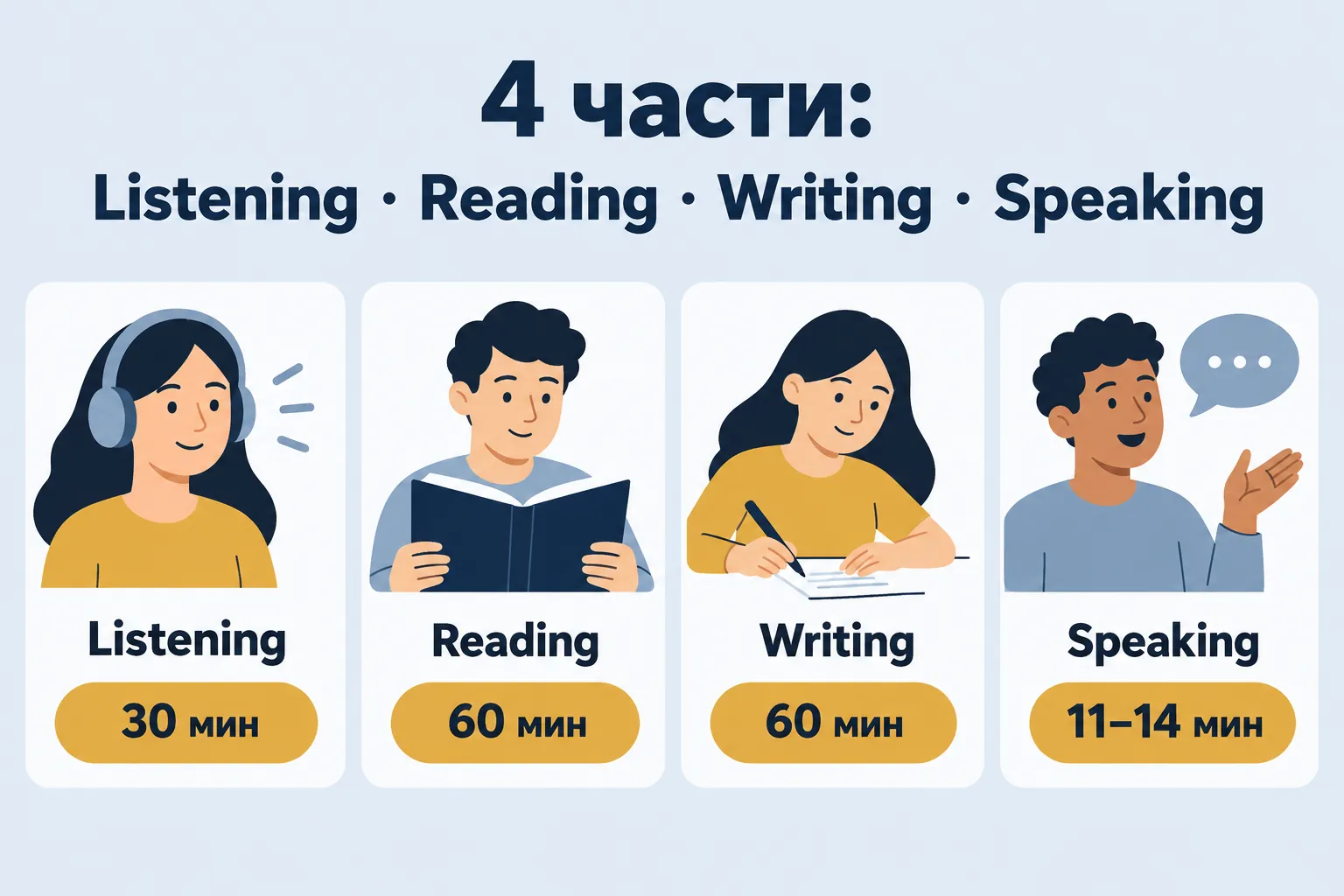
| Part | Time | What it assesses |
|---|---|---|
| Listening | about 30 minutes | listening comprehension: 4 recordings, 40 questions |
| Reading | 60 minutes | reading: 3 texts, 40 questions |
| Writing | 60 minutes | writing: Task 1 (describing a chart, graph or diagram for Academic) and Task 2 (essay) |
| Speaking | 11–14 minutes | face-to-face interview with an examiner: Part 1, Part 2 (cue card) and Part 3 |
Each part is described in detail in the article IELTS Academic format, and all task types are collected in the article IELTS task types.
How band scores are calculated
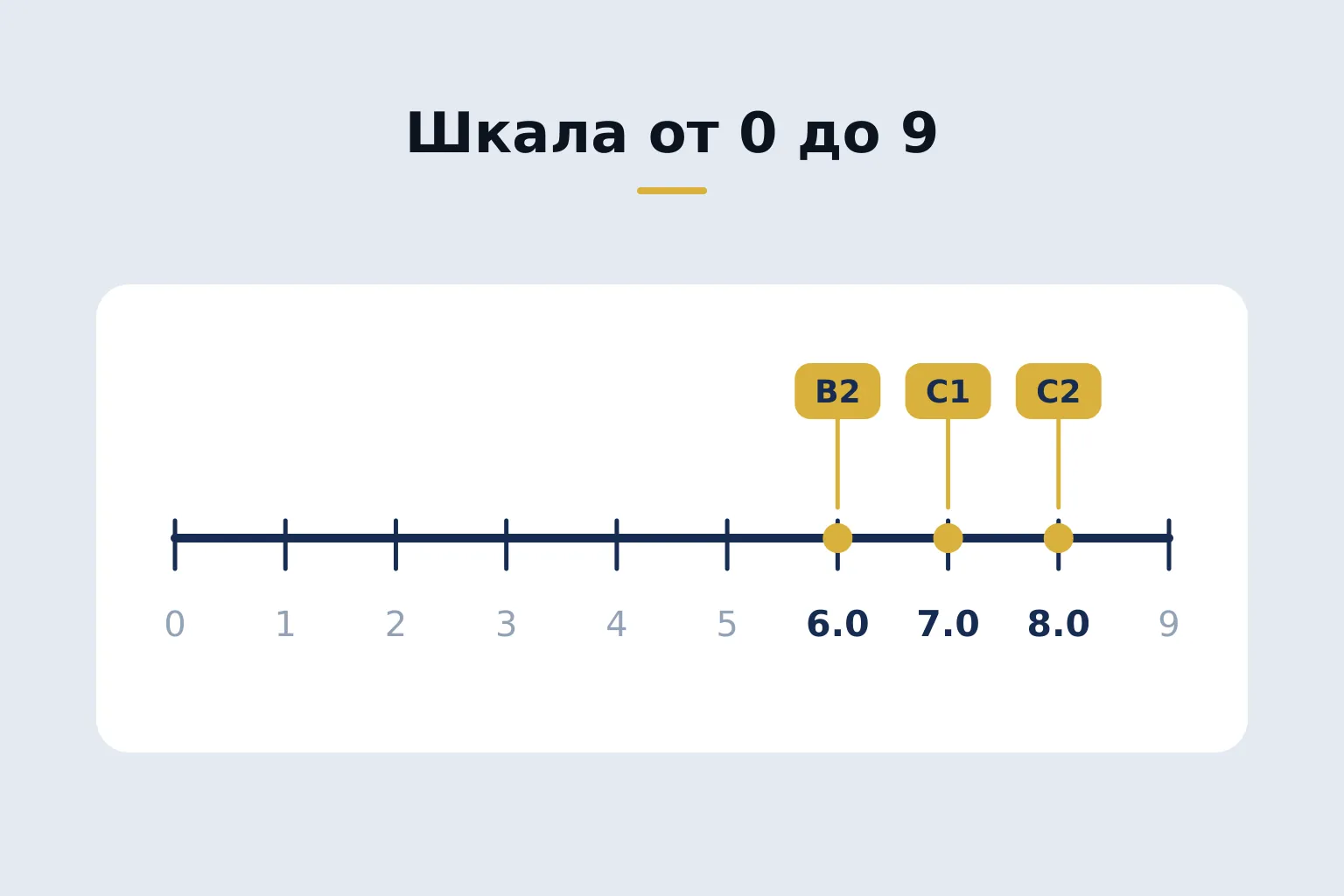
Each part is scored from 0 to 9 in half-band increments. The Overall band score is the average of the four parts rounded to the nearest 0.5. The scale has no pass or fail: each organisation sets its own minimum band score.
| Band | What it means | What it is usually enough for |
|---|---|---|
| 8.0–9.0 | very high level, C1–C2 | any study programme, maximum points in immigration systems |
| 7.0–7.5 | high level, C1 | leading universities, medicine and law |
| 6.0–6.5 | competent level, B2 | most undergraduate and postgraduate programmes |
| 5.0–5.5 | modest level, B1–B2 | foundation programmes, some visa requirements |
The four criteria for Writing (Task Achievement / Task Response, Coherence and Cohesion, Lexical Resource, Grammatical Range and Accuracy) and for Speaking (Fluency and Coherence, Lexical Resource, Grammatical Range and Accuracy, Pronunciation) are explained in detail, with tables for converting correct answers into band scores, in the article IELTS band scores.
Test format in 2026
IELTS is offered on paper and on computer, and availability of each format differs by country. Speaking is still held face-to-face with an examiner at a test centre. For updates that apply in your country, check the official IELTS booking website for your country (ielts.org lists the official booking sites). Learn more in the article What has changed in IELTS in 2026.
How much it costs and where to book
Test fees, available dates, test centre locations and booking deadlines differ by country. To check the exact price, nearest test centre and available dates for India, Pakistan, Nigeria or the Philippines, visit the official IELTS booking website for your country (ielts.org lists the official booking sites).
Results and validity
Results for a computer-based test are usually released within a few days, and for a paper-based test within about two weeks — exact timing depends on the test centre and country, so check your booking confirmation. The recommended validity is 2 years, as most institutions accept results for two years. Learn more in the article IELTS results.
How to prepare
- Find out your level. Take a full mock test online to get an «IELTS band forecast» for each part. This is an AI estimate to guide your practice, not an official score.
- Clarify the requirements of your goal. Check whether you need a minimum band score in each part or only an Overall band score, and what scores universities, employers or immigration programmes in your target country require.
- Make a plan that focuses on your weakest skill. Practise regularly and organise your preparation by skill. For timelines, see the article How long to prepare for IELTS.
- Practise in exam format and analyse your mistakes, not just your scores. Use smart presentations, flashcards and the grammar trainer in your dashboard to close gaps in Lexical Resource and Grammatical Range and Accuracy.
If your goal is 7.5 or higher, the complete preparation system is collected in the guide IELTS Academic for 8+. Sign in to your dashboard to track attempts, review results and get notifications about your progress.
FAQ
What is IELTS?
IELTS (International English Language Testing System) is an international English language test. Its results are accepted by universities, employers and immigration authorities in many countries.
How long is the IELTS test?
About 2 hours 45 minutes: Listening, Reading and Writing are taken consecutively and Speaking is on the same day or within a week.
What is the maximum IELTS band score?
9.0. Each section is scored from 0 to 9 in half-band increments and the Overall band score is the average rounded to the nearest half band.
How long is an IELTS certificate valid?
The recommended validity is 2 years, as most organisations accept results for two years.
Next step
Mock test
IELTS mock test
Listening, Reading, Writing and Speaking in the computer-based test format and IELTS band forecast on the 0–9 scale.
6 USDone-time
Go to mock testGuide
IELTS Academic for 8+: The Complete Preparation Strategy
The complete strategy: from diagnosis to exam day. No filler and no memorised templates.
15 USD
Open guide