How to Get IELTS Band 8 and Above: What It Really Takes
Updated
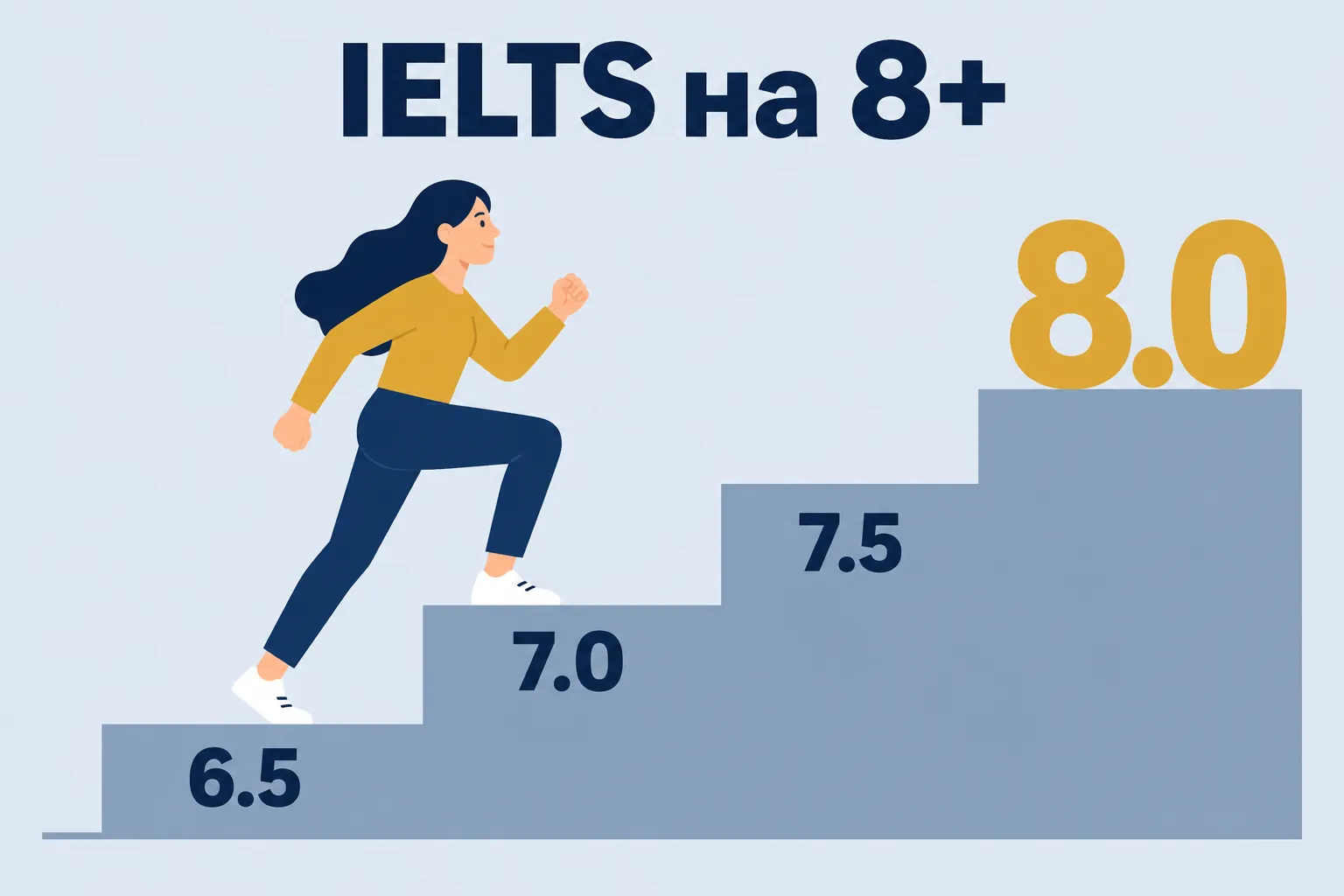
The IELTS scale runs from 0 to 9, so 8.0 and above is the very top of the exam. This score opens the most demanding opportunities: top master's programmes in the UK, Australia and Canada, professional registration for doctors and lawyers, and maximum points on immigration calculators for Canada, Australia and New Zealand. The good news: 8.0 does not require “perfect English”. It requires strategy.
Overall 8.0 is built where you least expect it
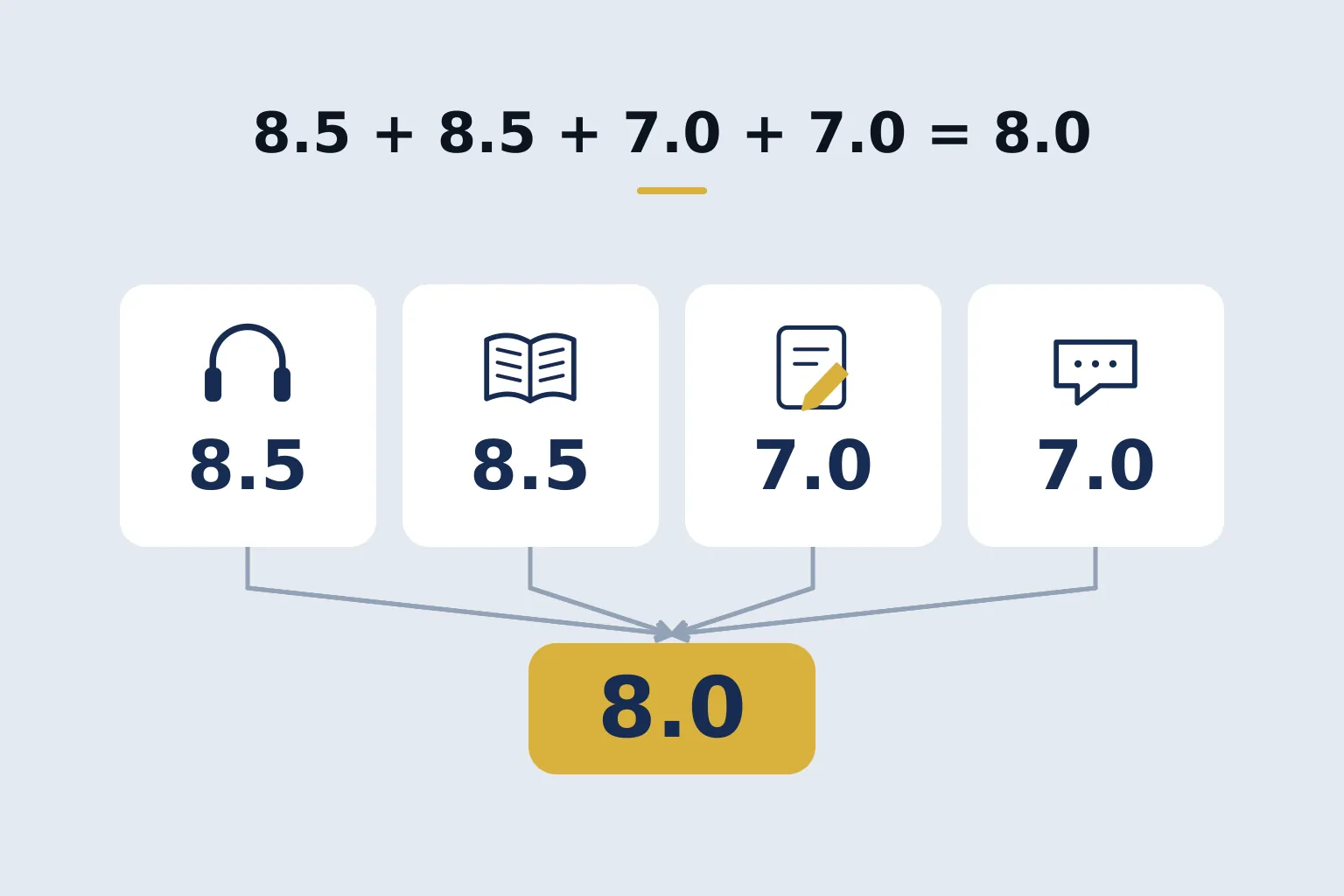
The Overall band score is the average of the four sections rounded to the nearest half or whole band: .25 rounds up to .5, .75 rounds up to the next whole band. Look at the combinations:
| Listening | Reading | Writing | Speaking | Overall |
|---|---|---|---|---|
| 8.5 | 8.5 | 7.0 | 7.0 | 8.0 |
| 9.0 | 8.0 | 7.0 | 7.0 | 8.0 |
| 8.0 | 8.0 | 7.5 | 7.5 | 8.0 |
| 8.5 | 8.0 | 7.0 | 7.0 | 7.5 |
Conclusion: for most test takers with Overall 8.0, Listening and Reading are at 8.5–9.0, while Writing and Speaking are at 7.0–7.5. Listening and Reading are marked objectively, and technique in these sections improves faster than productive skills. That is why the first weeks of preparation for band 8 are almost always spent on stopping the loss of marks in these two sections.
The exception is when your programme or visa requires a minimum in each section (for example, “no less than 7.5 in each section” for many universities in the UK, or for nursing registration in Australia). Then your weakest skill becomes the priority, and you will need to bring Writing up to 7.5.
How many mistakes can you afford
- Listening for 8.0: about 35–36 correct out of 40, i.e. no more than five mistakes.
- Reading Academic for 8.0: also about 35 out of 40.
- For 9.0: 39–40 out of 40 in both sections.
Almost all mistakes made by candidates at band 7 at this stage are technical: word limit, spelling, a missing -s, a trap correction in the audio, choosing False instead of Not Given. We analyse them in detail in the articles on Listening and True / False / Not Given.
How Writing and Speaking at band 8 differ from band 7
The difference is not in “clever words”. It is in precision and control:
- Errors are rare and non-systematic. At band 7 errors are noticeable; at band 8 most sentences are error-free.
- Vocabulary is precise, not rare. Natural collocation is valued: a heavy burden, a growing body of evidence. Pretentious words inserted just to impress lower your Lexical Resource score.
- Cohesion is almost invisible. Moreover and Furthermore in every paragraph is a sign of band 6–7. At band 8, linking is logical and varied.
- Ideas are fully developed. One idea is taken to its conclusion with an explanation and an example, rather than three ideas listed briefly. This is what Task Achievement / Task Response and Coherence and Cohesion reward.
- Speech has no pauses to search for words. A pause to think about content is normal; a pause to recall a word lowers your Fluency and Coherence score.
The band descriptors are explained in detail in the article “IELTS Writing Band Descriptors in Simple Words”.
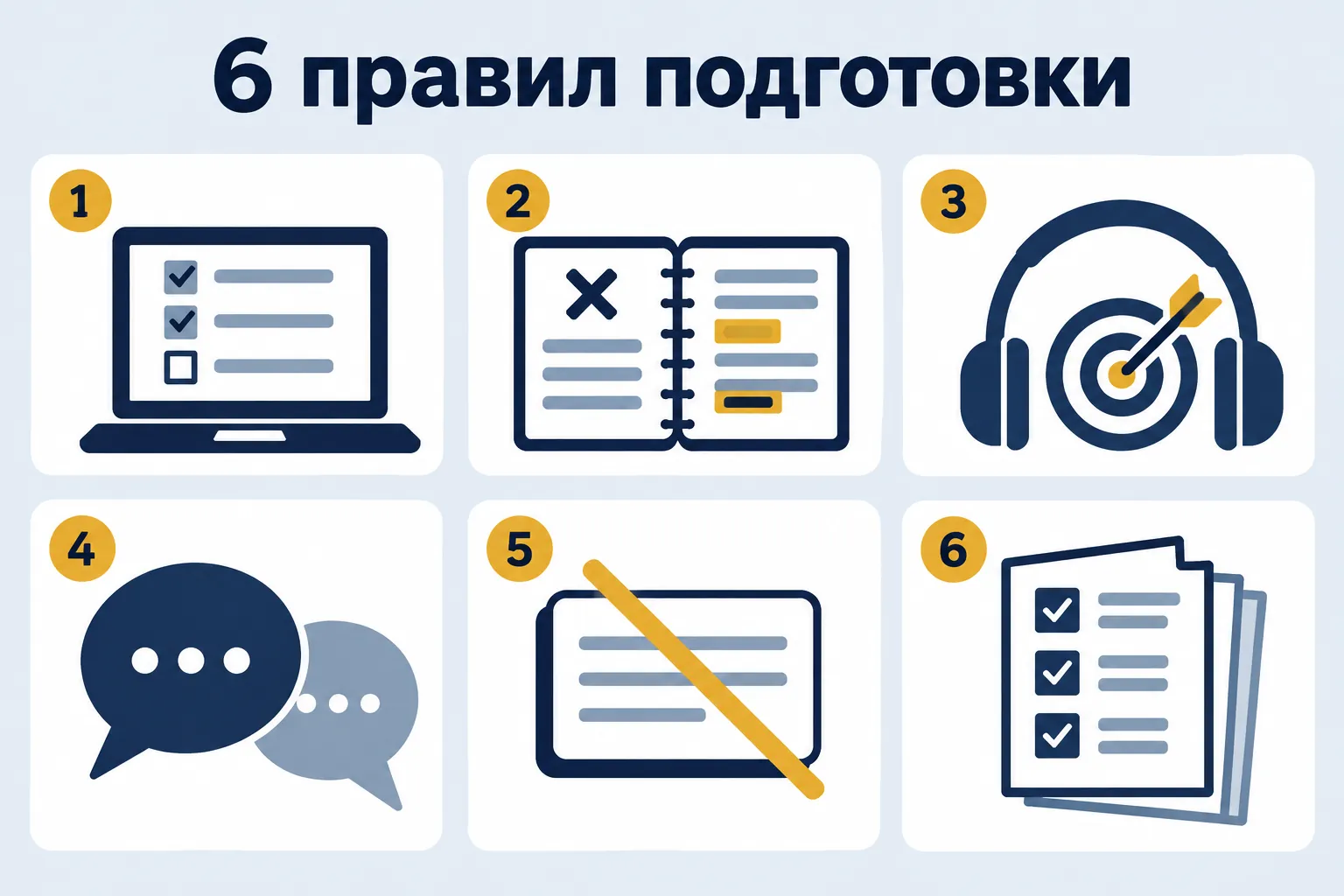
Six rules for preparing for band 8
- Start with a full mock test under exam conditions to know your band score in each section.
- Keep an error log, not just a record of scores. After a month, three to five recurring reasons for losing marks will emerge. That is your personal programme.
- Spend 40% of your time on your weakest skill.
- Practise Writing and Speaking with feedback against the four criteria — Task Achievement / Task Response, Coherence and Cohesion, Lexical Resource, Grammatical Range and Accuracy for Writing, and Fluency and Coherence, Lexical Resource, Grammatical Range and Accuracy, Pronunciation for Speaking — and rewrite your texts after feedback.
- Do not memorise ready-made answers. Examiners recognise them immediately and they lower your score for Task Response and Fluency and Coherence.
- The last three weeks — full mock tests on the schedule of the real exam.
Typical mistakes to fix before band 8
Test takers from India, Pakistan, Nigeria and the Philippines aiming for 7.5–8.0 most often lose marks for the same small, systematic errors:
- Articles and plurals: the education instead of education, informations and advices — these nouns are uncountable in English.
- Prepositions and verb patterns: discuss about, emphasise on, return back, according to me instead of in my opinion.
- Subject-verb agreement and tense control: especially Present Perfect vs Past Simple (I have completed my degree in 2021).
- Direct translation: make a photo instead of take a photo, in the internet instead of on the internet.
- Pronunciation and fluency: th sounds, v vs w, word stress (deVELop), flat intonation, and fillers (actually, basically, kind of) that lower Pronunciation and Fluency and Coherence.
It is these systematic slips, not a lack of advanced vocabulary, that most often separate 7.0 from 7.5 in Writing and Speaking.
Where to start
Take a full mock test and look at your band scores by section. If you need the whole system — 12-, 8- and 4-week plans, an error log template, the 15 most common mistakes and exam-day tactics — it is all collected in the guide “IELTS Academic for 8+”.
FAQ
Is it possible to get IELTS band 8 on your own?
Yes, if your starting level is around 7.0 and you prepare systematically: diagnostics, an error log, and feedback on Writing and Speaking against the band descriptors. Without feedback on Writing, progress is usually slow.
How many correct answers do you need for band 8 in Listening and Reading?
Around 35–36 out of 40 in both sections. Exact boundaries vary slightly from test to test.
Can you get Overall 8.0 if your Writing is 7.0?
Yes. For example, Listening 8.5, Reading 8.5, Writing 7.0 and Speaking 7.0 give an average of 7.75, which rounds up to 8.0.
How long does it take to prepare for IELTS band 8?
With a starting level of 7.0, it usually takes 8–12 weeks at 8–10 hours per week. With 6.0–6.5, it usually takes more than three months.
Next step
Mock test
IELTS mock test
Listening, Reading, Writing and Speaking in the computer-based test format and IELTS band forecast on the 0–9 scale.
6 USDone-time
Go to mock testGuide
IELTS Academic for 8+: The Complete Preparation Strategy
The complete strategy: from diagnosis to exam day. No filler and no memorised templates.
15 USD
Open guide