IELTS or TOEFL: Which Test to Take in 2026
Updated
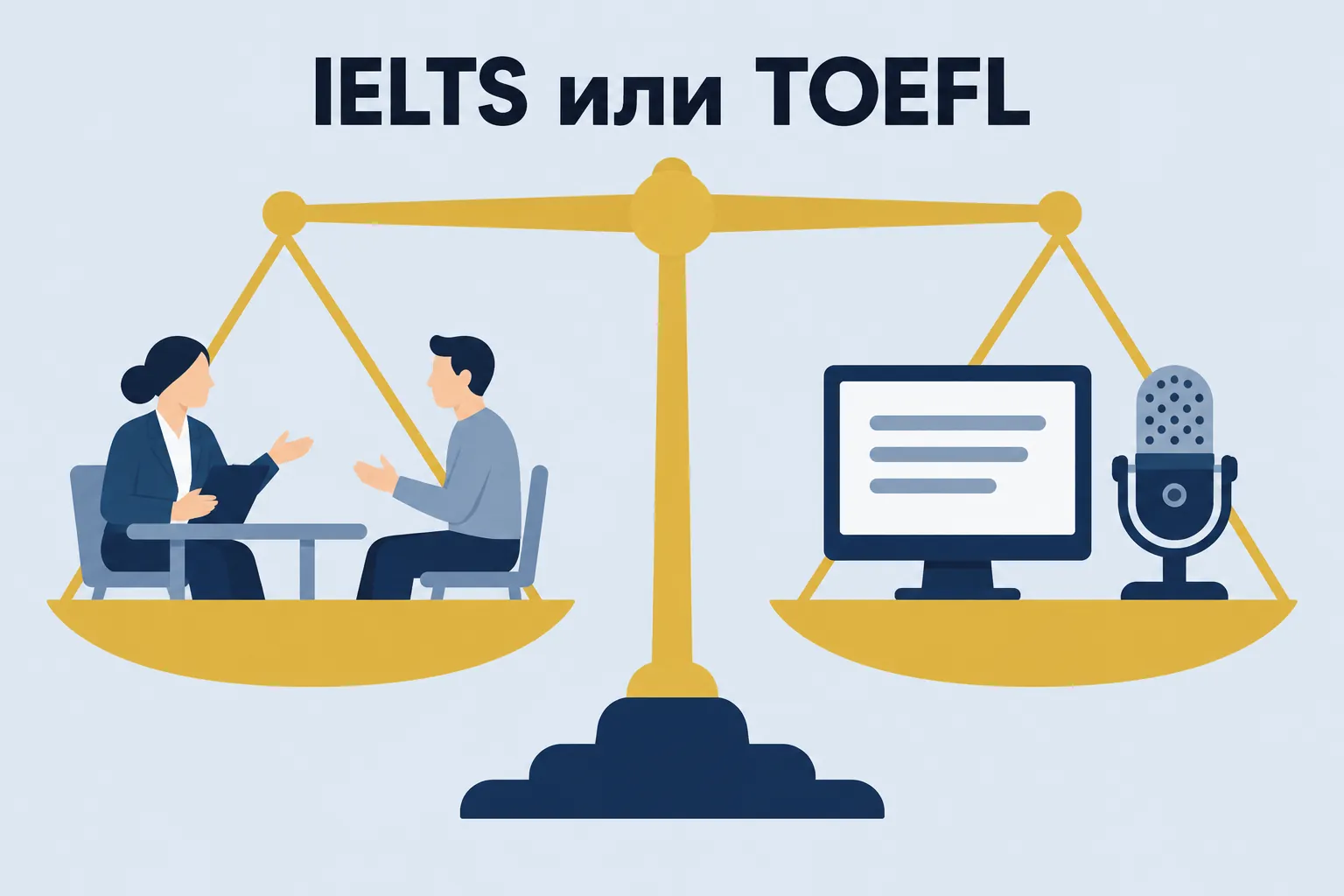
Both tests assess academic English and are accepted by most universities worldwide. The right choice depends on two things: what your target institution or organisation accepts and which format lets you best demonstrate your level.
Key Difference
| IELTS Academic | TOEFL iBT | |
|---|---|---|
| Speaking | face-to-face interview with an examiner, 11–14 minutes | responses recorded via microphone and scored from the recording |
| Format | on computer (from 2026), Writing on paper still available in some test centres | fully on computer |
| Scale | 0–9 in steps of 0.5 | 0–120 and, from 2026, an additional 1–6 scale aligned to the CEFR |
| Reading and Listening | fixed set of questions | adaptive from 2026: difficulty adjusts to your answers |
| English | British, Australian and other accents | mostly American academic English |

TOEFL Changes in 2026
From 21 January 2026, TOEFL iBT has been updated: Reading and Listening are now multi-stage adaptive, tasks have been made closer to real university life, and the score report now shows a 1–6 scale aligned to the CEFR alongside the 0–120 scale. Both scales will be shown during the transition period. Before choosing your test, check which TOEFL scores on the new scale your programme requires.
Who Accepts Which Test
- United Kingdom, Australia, New Zealand, Ireland have historically focused on IELTS, and it is required for most visas and professional registration.
- Canada accepts a limited list of tests for immigration, which includes IELTS General Training. Check the current list on the website of Immigration, Refugees and Citizenship Canada.
- USA — most universities accept both tests.
- Europe and Asia — usually both.
Always check the requirements of your specific programme or authority. If you are applying from India, Pakistan, Nigeria or the Philippines, confirm whether your university, employer or visa authority lists IELTS Academic, IELTS General Training or TOEFL iBT.
Who Should Choose IELTS
- You find it easier to speak to a person than to a microphone.
- You need a visa or professional registration in the United Kingdom or Australia.
- You are more familiar with British English.
Who Should Choose TOEFL
- You are more comfortable on a computer and type quickly.
- You are applying to the USA and your programme prefers TOEFL.
- You work well with long lectures in an American academic style.
If You Choose IELTS
Start with an IELTS mock test online to check your level, then study the IELTS Academic format. We explain our system for preparing to 7.5 and above in the guide “IELTS Academic for 8+”.
FAQ
Which is easier: IELTS or TOEFL?
It depends on you. IELTS is more convenient if you find it easier to speak to a real person and prefer shorter Reading texts. TOEFL suits those who are comfortable working on a computer and are used to American academic English.
Has TOEFL changed in 2026?
Yes. Since January 2026, TOEFL iBT has been updated: Reading and Listening have become adaptive, and the score report now shows a 1–6 scale aligned to the CEFR alongside the familiar 0–120 scale.
Do American universities accept IELTS?
Most do. But always check the requirements of your specific programme.
Next step
Mock test
IELTS mock test
Listening, Reading, Writing and Speaking in the computer-based test format and IELTS band forecast on the 0–9 scale.
6 USDone-time
Go to mock testGuide
IELTS Academic for 8+: The Complete Preparation Strategy
The complete strategy: from diagnosis to exam day. No filler and no memorised templates.
15 USD
Open guide