IELTS Test Online: How to Take a Mock Exam and Check Your Band Score
Updated
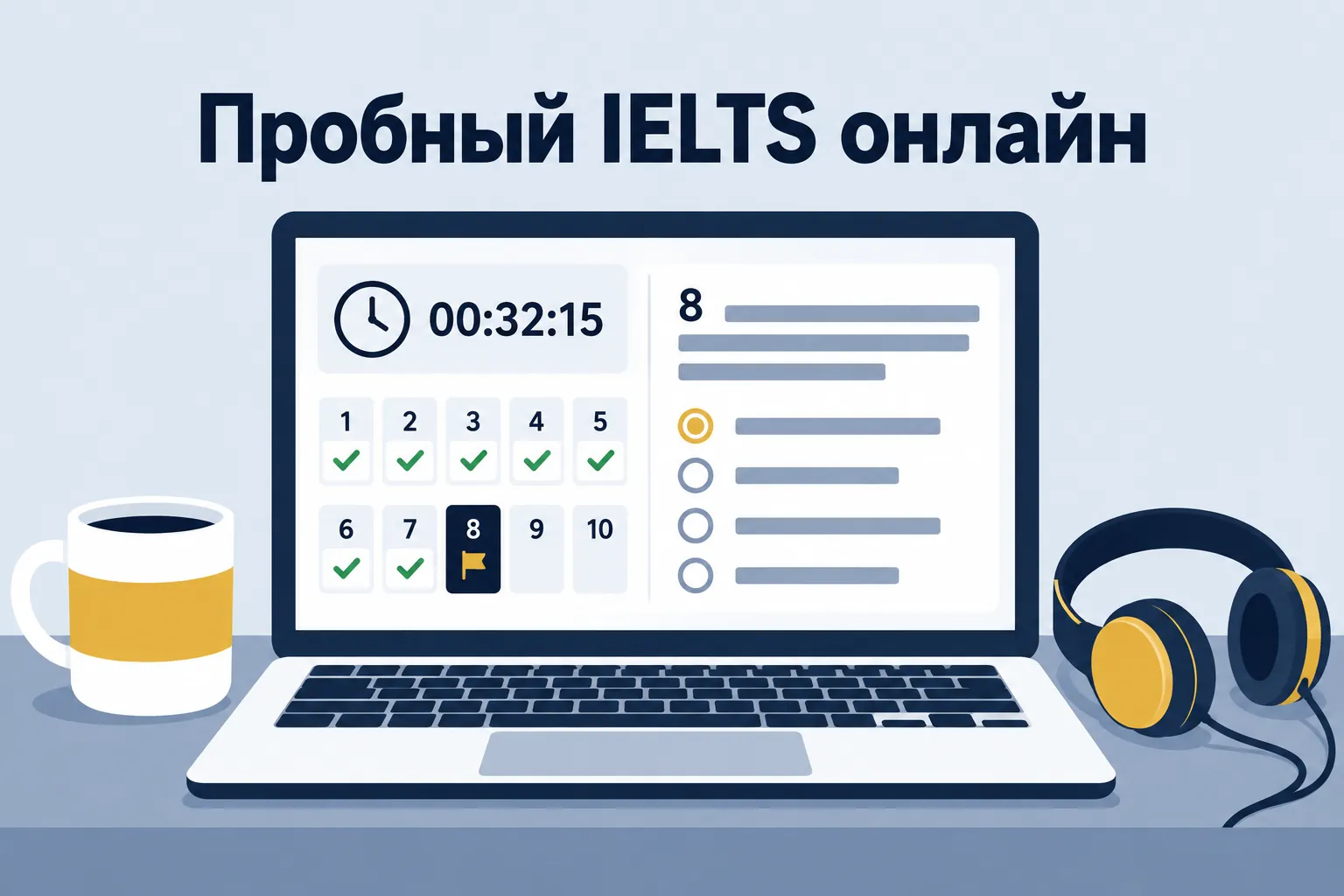
An IELTS mock test online is the fastest way to find out what band you would get in the real exam and what to work on next. But it only helps if it is built like the real exam and you sit it under exam conditions.
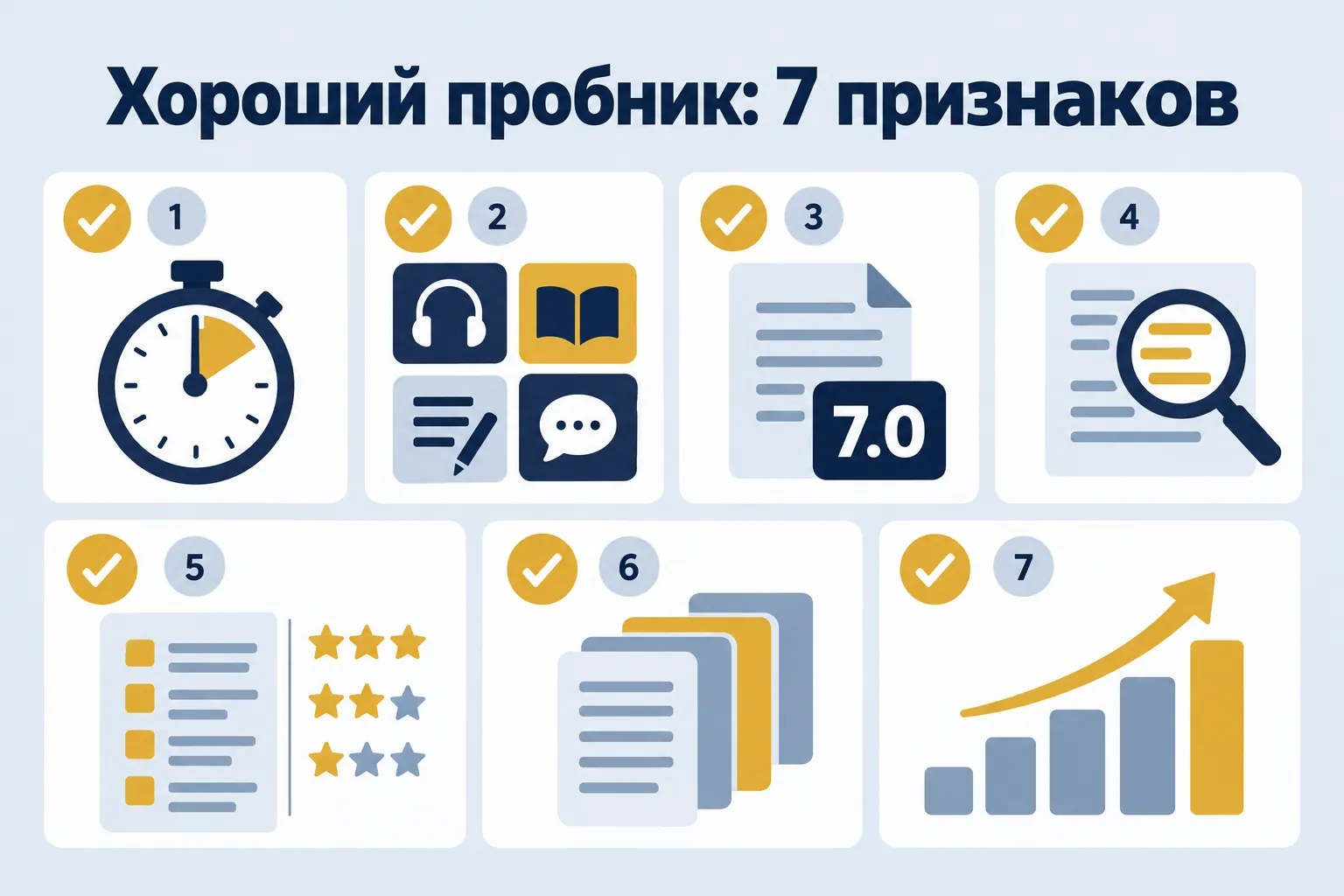
What a Good Mock Test Should Include
- All four sections in the correct order and volume: Listening (4 parts, 40 questions), Reading (3 passages, 40 questions), Writing (Task 1 and Task 2), Speaking (Part 1 / Part 2 / Part 3).
- Computer-delivered interface. IELTS is now largely computer-delivered, so you should practise in the same interface: timer, text highlighting, notes, flag for review, navigation by question number.
- Strict timing for each section, without pauses.
- Conversion of answers into band scores using the Listening and Reading tables and a correctly rounded Overall band score.
- Marking of Writing and Speaking against the four criteria, not by impression — Task Achievement / Task Response, Coherence and Cohesion, Lexical Resource, Grammatical Range and Accuracy (and Fluency and Coherence, Pronunciation for Speaking).
- Answer review: where the answer was in the passage or recording and why the wrong option is wrong.
- Original tasks. Sites that copy official books violate copyright and often contain errors.
How to Sit a Mock Test Correctly
- Choose the same start time as your real exam, usually in the morning.
- Put away your phone, dictionaries and translators.
- Sit Listening, Reading and Writing back-to-back, without breaks, as in the exam.
- Do not pause. If you interrupt the mock test, the score stops being a forecast.
- Record your Speaking and listen back to the whole recording.
How to Interpret Your Result
Do not look only at the Overall band score:
- Scores by section: where the biggest gap to your target is.
- Errors by question type: True / False / Not Given, Yes / No / Not Given, matching headings, form completion in Listening.
- Timing: which section you did not finish and why.
- Writing and Speaking criteria: which of the four is lowest.
This data becomes your preparation plan. How to build it is explained in the article “How Long to Prepare for IELTS”.
How Many Mock Tests Do You Need
- At the start of preparation — one full mock test for diagnosis.
- In the middle — short section-wise practice tests each week.
- In the final three weeks — one to two full mock tests per week.
- The last full mock test — 5–6 days before the exam, not the day before.
Mock Exam on IELTS Test
Our IELTS mock exam is built to these standards: an interface like the computer-delivered exam, a strict timer, original tasks, automatic conversion of answers into band scores and an IELTS band forecast for each section. The price of one mock test is $15.
For mock tests to bring progress, not just a number, you need a method for analysing mistakes. It is described in detail in the guides to Listening and Reading.
FAQ
Can I take the official IELTS online from home?
You can take a mock test from home. The official IELTS is taken at a test centre. The IELTS Online option from home is available only in selected countries and for specific purposes — check with your test centre.
How accurate is a mock test band score?
A good mock test gives a forecast accurate to about half a band for Listening and Reading. For Writing and Speaking, accuracy depends on marking against the four public criteria: Task Achievement / Task Response, Coherence and Cohesion, Lexical Resource, and Grammatical Range and Accuracy (Fluency and Coherence and Pronunciation for Speaking).
How many mock tests should I take before the exam?
Take at least three full mock tests under exam conditions, with the last one 5–6 days before your real exam.
Next step
Mock test
IELTS mock test
Listening, Reading, Writing and Speaking in the computer-based test format and IELTS band forecast on the 0–9 scale.
6 USDone-time
Go to mock testGuide
IELTS Academic for 8+: The Complete Preparation Strategy
The complete strategy: from diagnosis to exam day. No filler and no memorised templates.
15 USD
Open guide